Eine freie Initiative von Menschen bei  anthrowiki.at, anthrowiki.at,  anthro.world, anthro.world,  biodyn.wiki und biodyn.wiki und  steiner.wiki steiner.wikimit online Lesekreisen, Übungsgruppen, Vorträgen ... |
|
|
Use Google Translate for a raw translation of our pages into more than 100 languages. Please note that some mistranslations can occur due to machine translation. |





Farm from the perspective of the Agriculture course. The five-step concept - a lecture by Marcel Waldhausen, 2025: Unterschied zwischen den Versionen
Admin (Diskussion | Beiträge) Keine Bearbeitungszusammenfassung |
Admin (Diskussion | Beiträge) KKeine Bearbeitungszusammenfassung |
||
| Zeile 2: | Zeile 2: | ||
[[Marcel Waldhausen|| back to Marcel Waldhausen |]] | [[Marcel Waldhausen|| back to Marcel Waldhausen |]] | ||
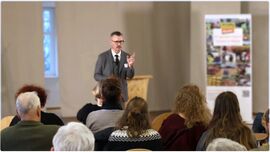
[[Datei:Marcel Waldhausen_2025-11-21.jpg|verweis=https://www.youtube.com/watch?v=K8oq45W83B0|thumb|[[Marcel Waldhausen]] on 21. | [[Datei:Marcel Waldhausen_2025-11-21.jpg|verweis=https://www.youtube.com/watch?v=K8oq45W83B0|thumb|[[Marcel Waldhausen]] on 21. November 2025 with his lecture on "Farm from the perspective of the Agriculture course. The five-step concept " [https://www.youtube.com/watch?v=K8oq45W83B0 Video here] ]] | ||
+++ This transcription had be made with the help of K.I. Would you like to help working out this text? Visit [[MitTun bei biodyn.wiki|MitTun]] +++ | +++ This transcription had be made with the help of K.I. Would you like to help working out this text? Visit [[MitTun bei biodyn.wiki|MitTun]] +++ | ||
Version vom 26. Dezember 2025, 20:36 Uhr
A B C D E F G H I J K L M N O P Q R S T U V W X Y Z | 0-9
+++ This transcription had be made with the help of K.I. Would you like to help working out this text? Visit MitTun +++
Introduction and Personal Connection 00:00:21
Hello to everyone. I'm very happy to be here. It was a long time to travel today because the flight was cancelled and stuff. Happened a lot of things, but finally I arrived so we can do what we want to do together. I have to say that some Finnish people changed my life forever. So, you know, if you are preparing to do something in another country, you are looking, okay, what's my relationship? And I looked very back in my past and I found that a Finnish person changed my life forever. So I would like to share this little story with you because it's the entrance to get into these topics.
When I was about 15 years old, I attended confirmation class in my local Christian Community in my hometown. And the preacher, the priest, he was from Finland. And there was a situation where he asked us to attend a speech in the evening from some young people that would like to share a project and stuff. So we agreed. We all went there and they were in the church and there were all the people and they showed us their project. And it was very interesting. It was from many young people all over Germany from the Christian Community and they found together to have a humanitarian project. And during the summer vacations, six weeks in Germany, during the summer vacations, they went to countries and built some construction sites there for the people, kindergartens, a hospital and so on. So I saw that and I signed the contract instantly there in the moment.
And the first project I attended was in Ukraine and we built a hospital for children that suffered from Chernobyl. It was 10 years after that, 10 years after Chernobyl. So we went there and we built a 25-bed hospital. So we collect all the construction material, we meet during the year, we work together to get the money together. So everybody was able to go there. So we did that. In other projects I found agriculture. I met my first wife. So you see a lot of important stuff happened because I attended this project. And there was one very, very important topic to learn. And it was if a group of people with an idea that is based on a spiritual look on the world or a spiritual idea, we are able to really change something altogether. And the name of the project was the Slingshot, you know, like David and Goliath, a little item that you need to change a huge problem.
You know, and this priest was mid-90s, you know, this priest, his name was Jukka Kuoppamäki. And he was a famous folk singer in Finland before. And they told us he was a famous folk singer. And he sacrificed this career to be a priest in the Christian Community. And we were like, wow, how great must it be to be a priest of the Christian Community, to sacrifice a career to work on an anthroposophical movement somewhere. You know, but the Christian Community, the church was full. All the families, all the children, we need to hire buses to go somewhere in the summer and stuff. So the Waldorf schools were full, you know, everything was like vital. The anthroposophical movement was like vital. You had researching people that were well known in the world of science. And they were open, known as anthroposophical people, you know. Imagine that today.
The 100-Year Rhythm of Impulses 00:05:12
And if we look what happened in the meantime, if we take today a look on our Christian Communities or Waldorf schools, there are seven people with white hair sitting there, you know. Yeah, they're nice people, but the movement is not that vital anymore. My wife, she's a teacher in a school with people with special needs, you know. And all the colleagues said, yeah, it's not the same like before. Something changed. It's not, the movement, it's not that vital anymore. What happened? Everybody's, you know. And you can perceive this, but for me, it was very necessary and peaceful for my mind to understand what is happening.
And there's something Rudolf Steiner said. If a social impulse that was researched, was picked up from the spiritual world, if this impulse becomes 100 years old, the original force, the force of this impulse is losing. It's becoming weaker. Is losing. We are losing this force, this power of the first improvement. And we have to revitalise, to re-impulse, to renew this impulse, to give him a future. If we do not, this impulse has to return to the spiritual world for another 100 years. And if you look when Rudolf Steiner started to develop Anthroposophy, it was in 1900, officially, Theosophical Society, then Anthroposophical Society, and so on, during 25 years. And when it started to getting weaker, the Anthroposophical Movement, around 2000. That's like a point of change there. And it's becoming weaker and weaker and weaker. And suddenly, nearly at the end, we are conscious about it. And the cycle of 100 years is closed in March 2025, with his death, 100 years of his death. So the cycle of 100 years of original impulse is done now. You know, we need to re-impulse.
So when I heard that, it was for me like, I know what I have to do now. That's the reason why I'm here this time. Because I would like to help to renovate this impulse. Because agriculture is the base for everything on earth. Without food, there's no existence. So I would like to help. It was like, wow, I know the direction now. But in the same moment, the question was, but how? You know, I'm not clairvoyant. I'm not initiated. I'm just a guy. So what can I do to help? So it took a lot of time for me to work this question, talking to people and asking them. And then I arrived to a point where I found for myself, everything is given yet. You know, there are 6200 lectures, 30 books. Everything is there, but I can't understand it yet. So there will not be another clairvoyant who takes the lead. We have to do it. We ask the people together.
So then I started to study the Agricultural Course with a certain method that I developed for myself, if you will. And during the next years, this Agricultural Course opens his doors and showed some of his secrets. And more and more, I get to an overview what it means to apply the Agricultural Course in practise today. And we all know the farmers don't have time to sit down and study eternally the Agricultural Course. But we need this knowledge and we need this in practise today. And I can tell you that there are a lot of answers for the actual questions that we have today in farming. They are all inside of this Agricultural Course. So after seven years of working that topic, someday this concept appeared in my mind. I was not searching or I was not sitting down to write down a concept. It was a specific lecture of Steiner, specific like a last piece that I need to understand. And immediately I started to work with this concept with practical farmers. And it's outstanding how this was working. It's not easy. It's a way to go through and to really... Everything is going to move after that. But you can really have some useful things. So let's start. Let's get into it.
First Stage: The Vision 00:11:52
I will try to do it quickly because we don't have so much time. If I start to work with a farm, first of all, I do this, what we are doing together now, I'm doing this with the farmers. So after that, they can really decide if they will. They really want to do it in their freedom. They know it now and then they are free to decide. So the same for you now. There is always like a first name of each stage. It's the first one. It's like an anthroposophical name. Not everybody is familiar with anthroposophical stuff. So there's another more polite name.
So we have the first stage and the first stage is about the vision that we have, why we are doing that. So I ask first of all, the first question to the farmers is, what's your favourite work? What's the reason why you stand up every morning? What is the work that you love the most on your farm? Because how's the reality? We do a lot of work and we do a lot of work that we have to do because it has to be done. But it's not why we're loving it. And if you love cows, it's good to have milking cows. But if you don't like cows, it's better you don't have them. If you don't like to ride a tractor, don't do the crops. Do other things. If you like to sell stuff, great. But if you don't like it, it's a torture for you. So everything that you love to do, you will do it very, very good. And often it's the first time that the farmers are asking this question. You know what? Wait, what's my favourite? And we try to penetrate to the inner vision, why they started to do a job like this, because every normal people will not do a farming job. You are crazy if you do it, really. You have to put a lot of money, you have to put a lot of work, and you don't know if by the weather conditions and stuff, at the end of the year you will have something. So if you do tools or something, you do it one year perhaps, and then you quit. But farmers, kind of crazy people, they keep doing it. There's another thing that is moving them forward. So what is this? What is this motive that we have? What is our vision? So you can imagine, it's a time we need to work on this topic.
The Unique Farm Context 00:14:39
So after that, we look at the farm, because every farm is unique. There's no farm similar in the world. Your farm is a unique place. And the foundation to understand that is the geological foundation. And Rudolf Steiner asked us to study that. And it's very important to study that, because we can learn a lot about it. I will mention this, but we will not dive very deep into it. We have a climate that is specific. In Finland it's different than in Germany and so on. But in the same land, in the same country, you have very different conditions. In my region where I work, I have 130 farms, from 400 hectares to half a hectare. And I learned a lot about agriculture doing this job, because for me it was, I have to seed this wheat at that period of the year. And six weeks later, I appeared in some other region and they said, no, we are seeding now. Now for us it's perfect. It's like, wow, how different can it be in about 200 kilometres? So we have to really study that and get it clear.
And then we have a soil as the foundation. And the type of soil, the kind, how we work it. And so we have to know what kind of soil we have. Because on that soil, we will have a specific kind of plants that are able to create. Not every plant, you can seed it, but it will not grow. You have a specific kind of animal that is possible to have on your farm. And that's the question. What is the kind of animal that you love? And Steiner says that the mixture of the animals will give you the fertiliser that you need on this specific place. So it's to study manure. It's very important. Great.
And after that, you have a specific kind of human that likes to stay in that place. If you rethink the farms you know, they have like a typical kind of people that is attracted to. You have some farms that are very, a lot of tractors, kind of people. You have some do little things. It's a specific kind of people. So all that gives us a specific surrounding for our work. As I mentioned, we need to know our preferences. So, of course, you know, I like to clean the house. But in all the work of cleaning the house, there are some works I don't like that much. But there has to be done, you know, so some work you have to do, obvious. But have a clear and return to this point of why I like to do this work so much.
Marketing and the Welcome Gesture 00:18:14
So let's take this example to dive a little bit deeper into it. Marketing sounds like PowerPoint presentations and stuff. You know, it's necessary that we sell our products. All activities that we do selling our products is marketing. But we have to decide, do we like people that are coming to our farm to buy the products or not? It's more like we like to do farming, but with us, you know. So it's better you produce wheat and stuff. And once a year or twice, there are some trucks getting the stuff for two hours, some coffee and stuff. And the rest of the year you are with you and your people and stuff. But if you like to sell the products to the client on your farm, there's something changing now. Because, you know, you can agree to sell the products on your farm. But, you know, if you like to pass with a tractor and they are looking at the pigs and, oh, perhaps they talk to me. You know, you can have these feelings. You are in the mood of working. So it's important to take this step back, you know, because why are these people coming to our farms? What is the reason for that? Because in Germany you don't need to go to a farm to buy some food. Today you can get everything, every organic food in every kind of form and wherever you want. You can get it in a supermarket. There's no need to go to a farm, pay more, have the travel time, you know.
But what is the reason why they are going to visit our farm? And, you know, if you have children, that is a great point of turnaround in your life. Because suddenly you are willing to do something that before you never wanted to do. Like go to the zoo, visiting a farm, you know. But if you do, I observed some families coming to a farm during a workshop that I was giving there. So I was asking myself, why are they coming? Why? Because there's so much forest and playgrounds and stuff. But they are going to the farm visiting the animals, you know. And what the people want is to enter this living sphere of a farm, you know. The etheric forces that they can perceive. They are coming to enter the being, you know. They are inside. It's a little bit like returning to the belly of the mother, you know. But it's something like that. They come and they enter this sphere of life. And in my region there are some places, in the past there were farms, but today it's just a restaurant. And they have two sheep and some animals. And the people are coming from all over to eat their waffles there and have some time with the animals. So there's a strong need in the human being to connect. And the animal is easy to connect because it's on the feeling side, if you will. It's not the plant. They are not visiting our fields, you know. They are visiting the sheep, the cows, the pigs, the chickens, you know. But they are coming to visit us. And we let them enter. And in the best situation, they buy some of our products, too.
If we take a closer look at what this means, because, you know, the carrots that we grow. Imagine the process. You know, we see the carrots growing. And during the time of growth, this carrot is perceiving and concentrating everything that is living on our farm. The soil, you know, the weather conditions, the social environment. Everything is concentrating in a point, like a storage of these forces that we have on our farm. We harvest the carrot, we put it in the shop, and somebody buys it. And he takes this carrot home. And then he is preparing a meal, you know. And while he is eating that carrot, all that is spreading inside this person, you know. It's like freeing all these influences that we concentrated in this carrot. So it's more like a very friendly gesture. You know, like a present that we give. They give us money, okay, we need money to grow more carrots. But that's not the point, you know.
And look, in Germany, perhaps, it's like, if you look where is the shop located on your farm. Often at the edge, in some edgy position, you know. It's logical, the clients can come, they can park their car, they enter the shop, they leave the shop. And they don't interrupt our farm work, you know. But imagine that you are inviting someone to your house. Someone is coming, rings the bell, you open, and you stay there, and you give him a cup of coffee. You drink the coffee, and when he's finished, thank you, nice, but now you can go again. You would never ever do that. You would take the person inside in the living room, sitting there, have some cakes, you know. But we are doing something similar with the clients. If we are always thinking, please don't ask me something, or can you move, you know. You don't have to talk for hours with everyone, that's not needed. But if your inner vision or your inner image is welcome, you know, nice that you have come to our farm. That will change everything. And if someday you have some piece of time and you talk to them, for them it's the group. We talked to the farmer. Yeah, you know, for them it's a word, perhaps, with the children, you know. So I try to move these images to you to understand we can look a bit different on our daily work and re-impulse it, if you will.
So the last point on the first stage is it's very important to know the history of the place. You know, because you can work with the place or you can work against the place. A quick example, if you do the garden today and before the nuns of a convent did this garden for centuries. And they were praying and they were doing garden work and they were praying and doing garden work. You can imagine there might be a good energy, if you will, in this place, you know. But if you are doing today a garden that was the garden of a concentration camp, you can imagine the energy will be different. And perhaps you have something to do with this energy. Perhaps you have something to work on together with this place. So the question is, if you know what's the history of the place, you can get into a relationship. If you don't know this history of the place, maybe you're struggling against. Okay, so let's move forward.
Second Stage: Tools and Fertilisation Cascade 00:27:15
We had the question, what is the vision? Now it's the question, how can we get it done? What are our tools? How can we work that? And this includes all the practical ideas of the Agricultural Course. But we have to look close, have a closer look on that. Because, you know, the first generation that heard that didn't understand it all, you know, but they started. And they were carried by this impulse, you know. The first generation that heard Steiner, you know, these people were very, very encouraged and very, very moving forward. So you have a second generation. They learned it by people that heard it from the original, if you will, the original energy, you know. So that was strong, too. And they were studying the Agricultural Course and so on. And then you have a third generation that learned it from the people, that learned it from people that heard it, the original. But they didn't study anymore. They just were doing the things. And there's a famous game with children. You say something in one ear and it's a big round, you know. And at the end, the word is different, you know, something very different. That happened to the Agricultural Course, too. We have a lot of dogma that had nothing to do with the original. The idea was the opposite sometimes, you know.
So it's very important to really understand what it means. So we had a big confusion between the closed farm organism and the closed farm individuality. That's a huge difference. We will see it in the third stage. So the closed farm organism means that we are able to have everything that we need to get the life on our farm. But that means not that we have to build the tractor wheels and had some copper to do some electric cables and stuff, you know. If we had the energy by our own, perfect. If not, you can have a perfect closed farm organism buying electricity or water or whatever it is. But that you have the animal that you need and the plants that you need and the soil that you're working with, the fertilisation that you have because of the animals and stuff. These things, it's important to have them as closed as possible. But that means not to not buy a bull. That means not to buy some seeds, you know, you have to take it practical. Rudolf Steiner was so practical. He was never like he was. He wanted to get it into the shuffle, you know. And we are today, we are able to really get it into the shuffle in the entire idea.
So and for that, we're doing something like that. So you can imagine we have to work a lot about this question to really see how it works on your farm. So the fertilisation cascade. That is something so, so excellent that Steiner developed during the Agricultural Course. You know, he said it's one of the greatest mysteries, the fertilisation. One of the greatest mysteries. You know, if I hear something like that, I want to understand what is the mystery behind. I tried to research it, you know, it's like. So. What are we doing today? We are having our manure. We put some preparations inside and that's it. That is like. One step of four, you know.
So the cascade started and he explains how nutrition is working. We will see it in the fifth stage, how nutrition is working. Then he developed an entire cascade, how to apply the fertilisation on your farm. It starts with a plant's compost. You know, we say compost to everything today in biodynamics, but in the Agriculture Course, it's not the case. Compost is only a plant's compost. Only plants. Without anything that is coming from digestion of the animal, if you will. You can put dead animals inside and stuff, but he gives us the form how to build this pile of compost. So with this plant's compost, we need to fertilise our grassland. Then we will have a product, the hay, with a very good quality. It's the same like in nutrition. We will see nutrition in the fifth stage. So. And then we have the animal itself that really is doing this digestion at the highest level possible on earth. The cows are incredible. And what is coming out of that? The manure. Steiner arrived during the Agricultural Course. He says this is the same as brain material. The same stuff as our brain. We need to work this very slowly. I give you the ideas to show where the questions are. And then we have the manure and we put preparations in it. But we can ask a question, for example. If this is really brain material that we have as the manure. What is happening if we are making the 500 preparations out of it? What's really happening then? You see this, everything is interrelated. The Agricultural Course, everything, there's no one word, just like that. Everything is interrelated.
Preparations and Ashes 00:34:36
We need to know everything about preparations and ashes. We don't know everything. There's so much that we can do with preparations that we don't even know. The possibilities we have with this. A quick example. You can apply 500 in the morning and in the evening. You can apply 500 one in the morning and in the evening. And we're doing one in the morning, one in the evening. You know, it's like dogmatic stuff. No, we have a lot more possibilities. We look at it as a tool in our box of tools. And then you can be creative if you understand what is this all about. And by the way, the farmers are asking Steiner in the first possibility to ask questions after the fourth lecture, where he developed the fertilisation and the 500 preparations. They're asking, what should we do with all the manure that is over? Because we have this new super manure in the 500 horns. But there's a lot of manure that we have there. What should we do with that? Should we put it in the field and make a compost of it? And he said, don't do that. Use it as you are using it today. So what did we do the last 100 years? We made compost out of our manure. We can see today why this happened. But you see, this is because somebody told someone something and this became a dogma. And everyone is doing that without knowing what's the idea of it. And for that, it's so important to really dig deep into this stuff.
Getty Images The ashes are the same. In the 90s, there were a research of the Dottenfelder Hof and they found that the ashes are not working. And everyone was, no, ashes are not working. I think he did it wrong. So for me, I was young. I was in my apprenticeship time in agriculture. They were like, you believe in this Hogwarts stuff, preparations and so on, but the other Hogwarts stuff not. But what's the truth? How can I really think that's right what I'm doing? Then we visited a farmer. He was working at a 1,200 hectares farm in Berlin. And he was only doing the preparations. And he had some potatoes for his own research. And there were these little, the little beetles, these potato beetles. You know them? Yeah. And we have to collect them in a break. And we did it. And everyone in his farm was collecting beetles, everyone. But these beetles were so slow, you know, so like in slow motion. They ask him, Christoph, what is happening to your beetles? Oh, yeah, that's the third year of the ashes. And after that, we read the sixth lecture. And there Steiner is describing that this will happen, that they will get a certain weakness after the time. And we were able to see this weakness in the beetle, you know. And that was a very important moment for my life to understand this thing is working totally. But I didn't understand it yet.
Sprecher 2: There are classes for how do you make it. People don't know about how they make the ashes.
Sprecher 1: Yeah, yeah, that we can talk in post or after that. OK, let's let's get through it. And the special detail. There are 200,000 questions now, you know. Yeah, we need at the end, we need seeds and animal breeding. There's no way out. We have to confront the bull at his horns, take it there and start to work. And they are very, very good results today. Very good results in seed breeding, for wheat, for a lot of stuff. We can talk about that, too. OK, so and now we change to the third stage.
Third Stage: Farm Individuality 00:39:32
And, you know, farm individuality. This is this is something very, very important. So we will we will take the most time. And there's no other title that I was able to develop. Farm individuality is farm individuality and nothing else. So there's no chance. OK, so we have to ask ourselves the question, what is an individuality? What does it mean? And if we take the the image that Steiner developed in Anthroposophy about the individuality. Only the human being is an individuality on Earth. Only the human being. The animals, the plants, the stones, they have something similar, but it's not incarnated on Earth. That's the great difference. And we as a human being, we have our eye [I] and the eye [I]. That's that's the turning point. That's what makes the difference. But that's not the individuality.
If we take Steiner series there, we have if we are incarnated, we have a physical body. We have a etheric body, astralic body and the eye [I]. And then we have three other like bodies that maintains in the spiritual world. In the future, we will develop them as the body, as the etheric and astralic body. So this is something that's happening in the future. That is important to know, because if we incarnate, before we ask some questions, we work with the soul. We will incarnate together and with the forces who work the fate, if you will. So we are absolutely conscious of what our tasks and stories in life will be. But if we incarnate, we forget that. And we need to forget that because we need to be free on Earth. If not, imagine you have: "Ah, yeah, no. Tomorrow I will meet the man or woman of my life. We have three children. He is a farmer. Oh, my God, I don't go there." You know, this could happen. So we need this freedom to really decide in life, in the situation. You know, it's important. But these three bodies in the spiritual world, they know everything. Our past, all the incarnations we had and the actual task we have. So during the night we connect with this parts of our individuality. And, you know, if you have to take a very important decision, you sleep one night about this decision or more nights. But you will sleep before a very, very big. And that's reality. We are connecting with our karmic current and really ask if it's OK to do so. That's concrete, you know, that's reality.
So how Rudolf Steiner is able to call a farm an individuality? If only the human being is an individuality. You see where the question is, it's a very huge question, very huge. You know, and I do it. There's a master key he gives us after the fourth lecture. He says everything is based on the human being. All what I'm saying, all I'm talking about is based on the human being. So you can take all that you know about the human being from anthroposophy to understand the farm individuality. And so I do it like mathematics. What exists for the farm individuality must exist for the human being. And what exists for the human being must exist for the farm individuality. So you are all the way, I do like a ping pong stuff. And you can find that's the way you can do it. I will show some examples. So he developed organs. It's a being. If you have an individuality, you need a body, you know, for an incarnation. And he starts in the second lecture, opening the second lecture, he starts with the individuality. And in the eighth lecture, at the very end, he said, and for that we are talking about an organism. So first you have the spiritual being, and then you will have the body. It's not the other way around. So we can look at our farm as a being that is on a similar height. And all that we have physically on our farm is the body. Everything.
Individuality vs. Personality 00:45:34
Let's take another step. If I would ask you, what's the difference between an individuality and a personality? It's not that easy to find the answer. What's the difference between personality and individuality? No, there is a difference because we have these two words. So there must be something. It's not the same, you know. If we were sitting on the farm table, we'd take all the time we have, but we need to go on. So Steiner answered this question. He said, you know, Goethe is considered as a great personality. Everyone considers Goethe as a great personality. But you know, the individuality is the eternal part of our being. What is going from life to life to life, you know. And the personality is the expression of this eternal being, the individuality, in one life. So Goethe as a great personality was the expression of Goethe's individuality in this life when he was Goethe. He had lives before, after, you know. That's important.
How we as humans develop. We are working on earth, on our topics, on our lives and stuff. Then we return to the spiritual world. We keep going. We work. And before we go in another incarnation, we work again. We prepare everything, you know. That's the way we do it. She [the Farm Individuality] is unable to do that. The farm individuality is attached to that place. She can't leave. He expressed it in the course. He said it's a being that is attached to the eternal of time and room, if you will. And that's only on earth. You don't have it in the spiritual world. So she's there for all the time. She will stay there. She can't leave. The farm individuality. We can incarnate, excarnate. As she can't. But if it's the same, the individuality like the human individuality, we need to have a personality. And the personality is the actual situation on your farm. How it's today. With the people that are working there, that's the personality. I will explain it.
Relationship between Farmer and Farm Individuality 00:48:20
So now we have like a connection. We have a relationship between the farmers and the agricultural individuality. And I will show you an example. If you have cattle. Some nights you wake up at three in the morning. There's no noise. There's silence. But you wake up and you get so conscious. I guess I will have a look at the animals. And you go down to the stable. And something is happening. Someone is stuck in a place. Or water pumps are spreading water. Whatever it is. It doesn't matter. But you wake up for that. And there's no noise. Nobody has come to shake you. It's her. She's calling you. Saying, wake up. There's something wrong.
So an example. I was working on a farm. And the farmers were gone somewhere. And I was there with another guy. And we had to seed wheat there. In winter time. Winter wheat. And during the week there was always other work to do. So everything was ready to go. But I never arrived at the moment. And one morning. I woke up. Today I have to seed the seeds. And I did it. And with the last pass on the field. The snow began to fall. And then it was winter there. No other choice to seed the wheat. So I heard her. And I did what she wanted me to do. Because she is way wiser than us. We are intellectual. She is wise. She knows everything. It's a being that likes to relate with us.
And how is this relationship possible? We heard about the circles. And all this stuff. It's always about the social question. Everything. The entire agriculture course. We will hear tomorrow a little bit. So there is a relationship between the farmers. And the agricultural individuality. And you can imagine. If you think in children. Because if a family. Has the first child. They become a barrier of this child. The woman first of all in her belly. She is carrying it. Literally. And after that we will carry these children. The entire life as parents. More or less. If they are 30 years old. "Dad, my car is broken. Can you help me?" You get into the car. It's not every day. Like before. But you never lose this. Exactly like that.
So. We take these children. And if we lay a baby. There. At the very beginning. They are like in another sphere. If you look at them. They are there. But they are not connecting with you. It takes a time. Until they will connect with you. But we know. That this human being. Will be. A complete human being. In one moment. We consider that. And we are doing all. That we are doing with them. Considering that. That it will become. An entire human being. With everything. The human being needs a human being. To become a human being. An animal is ready. If the small pigs. Were born. Three hours after they. Do the same thing at the wall. As the old pigs do. But the old pigs didn't show them. They are knowing it. They learn the specific rules. Of this place. How to broke something. And stuff. But they are ready as a pig. A human being is not ready as a human being. When they are born. You know Kaspar Hauser. This historic person. They don't talk to him. And he was unable to speak. So it's not normal. It's not. And it's so interesting. If you have some people. From other countries. For example somebody of Africa. And he is living in Germany. In Bavaria. In the deep south for us. They apply the same accent. And that's so. Interesting for us to see someone. From a very another country. To talk in the same. It's about. What are the relationships. If this person would live. In another place. They would apply the kind of speaking. From that place. It's so interesting how this is working.
So. With the very first sentence. Steiner used to introduce. The agricultural individuality. He said. She can. Fulfil her being. In the best way possible. If she is recognised. As. A closed individuality. If we are recognising her. If we take it seriously. That she is a being. Like we do it with a baby. Knowing this will be a human being. We do the same. And what is happening. After a while. The farmer. The farming people. Becomes a barrier. Of this being. Like the children. You are like a parent. In a way.
Farm Succession 00:54:41
You can study that. If a farm must be handled. Over to the next generation. That is one of the worst. And difficult moments. In farmers life. Handle the farm over. It's nearly impossible to do. In Germany. More than 90 percent. Are failing. Of this process. And they have a lot of help. There are a lot of people specialised. In handle over a farm. But we have so many cases. Where everything is alright. The money. Everything. And they go to put the farm. And they are unable. To do that. They can't.
So what is happening there. You know. The farmer and the farm individuality. Are becoming. One body. You know. In fact. Because we eat all the products from our farm. Building our body with these products. It's the communion. Of this. It's part of her body. And we are going through the farm. Doing our work and we are losing hair. And everything. You know. And she is consuming that. Forming her body. It's becoming the same. And that's on the physical. Place. But internal. They become a barrier. They are carrying. This being. You know. I had a situation. Where young farmers. Started a farm. And the elder ones were living. Downstairs and they were not talking. To each other anymore. And she was there with a little baby on her arm. I told her. Imagine. That we are sitting here one week together. And it's very nice. We are so on the same. Level. And after a week I say. Give me your child. And go. And she moved like that. Automatically. But absolutely correct. But imagine that. On the level of a farm. 30 years. Being one. Handle it over. To someone. It's nearly impossible. You can't do it like that. But it's necessary to do. So how we get there. How can we do that. It's always with the children. I loved. To bring my children to kindergarten. The first time. Two weeks. Three weeks. Where you can be part of the kindergarten. It's the best moment. You are sitting there with small tables. And they create every day. This world for these children. And I know it's. It's important for them to go there. It's important for us. That we send them there. And the people that are working. They will do it very good. But you know. When I have to leave the children. I cried every time. You can't do it without. It's sad. Because it's like. Like a first goodbye. That you have to say in life. It's important. Because they need to become. A real human being. You won't carry it. Really. When they are 30. But you can go. Through this pain. Because you know. It's important. You are willing to go through. And it becomes wisdom. If you will. And school. Who is not crying. When they pass this floor. Door there. In Waldorf school. But we know that's good for them. So. If we can be conscious. As farmers. And as young farmers. That this is happening. That we have to handle over. Something from ourselves. We can do that. It will be. Full of. Pain. You know. It's impossible without. But if we are conscious to go through. This pain can become wisdom too. So the question of consciousness. To be able to do it. It's a process. You can't say it's a week. It's the time that in this place. Is needed. To really handle it over. So that's very important. We will see tomorrow. A little bit more. About the agricultural individuality.
Fourth Stage: Forming the Farm Body 00:59:44
So. Now. And just now. When we. Had a. A relationship. With the farm individuality. We are allowed to. Really form her body. Because what we are doing. As farmers is. We work on. In and with. The body of the agricultural individuality. And you know. If we have a connection with her. She will say. Where we plant the trees. In the best situation. Because how often. Had we plant trees. Somewhere where we thought. It was a very very nice place. And after 10 years. I think. It was wrong. You know. But the trees are already there. So you don't go to cut them down. But it was a wrong decision. You know. And this is on longer terms. And if you want to plant a tree. Steiner started. In the first lecture. If you. Want to plant a tree. You have to know about the planetary. Movements. You have to know about astronomy. Then. You will plant. A good tree. The right tree in the right situation. And if we have trees. They are related with Saturn. For example. We have like 15 years. Or 30 years. To decide. It's not. The trees are there. And next week. All the pupils from the Waldorf School will be there. We will plant the trees. No. That will not last. So. We can do it better. If we are in touch. If we are connected.
So then. We have today. Agroforest. If they plant trees. You know. I had a workshop with them. And there was. You know. The cattle love the bushes. They are eating it. And I was. Yes. And this is what Rudolf Steiner says. In the agriculture course 100 years before. Everything is there. And today. We are able to have. The right practise for it. Because agroforest. Today we have the system. To apply it very well. You know. So if we get these two things together. We can move everything. We can do everything. So. It's important for us to know about trees. About bushes. Put this leaf for mushroom. The shire where all the. Little. Beetles and stuff. Will go. That we don't want to have on our cultures. On our crops. If we take it seriously. It will work. But we. We don't take it seriously. Or not seriously enough. We need to know about astronomy. We will do it. So okay. We are at the end now people. Sorry. It's a lot of stuff. But I like to show you. The whole idea. So you can better. Decide.
Fifth Stage: The Social Question and Nutrition 01:03:24
The social question. Or the conclusion. We can ask ourselves. Why are we doing that? Why are we doing preparations? And all this stuff. Because. Normal ecological. Farming is working too. Why? And I think it's important. To have the vision. It's important to know. Why I'm doing that. Because if I don't know why. It's everyday like. Everything is possible. But if I have a vision. Life will move you. But you are still. Aiming the goal. It's important to have this goal. It's the most important. To understand why. You are sacrificing so much. In your life. Why exactly? And for that we need to understand. A quick understanding. Of how nutrition works. How nutrition works. Like in the agriculture course.
Normally we are thinking. That all that we are eating. Is forming our body. Steiner said that is not the case. What we are eating. Is just. We are warm. We are full of will. Strength and all that. We are movable. And our senses. Are like. Prepared. To receive. Cosmic material. If you will. Cosmic forces from outside. And with this. We will form our body. When I heard this for the first time. I was like. Alles klar. It's unbelievable. We can't understand it. During the agriculture course. Nobody was asking him. How is that working? But after the course. He gave a lecture. For the workers at the Goetheanum. Every Wednesday. He went there. And gave them a speech. And there he is explaining how that works. And it's all about. Proteins. He said. You eat a plant. And you get the protein from the plant. And you have. Nitrogen. You have. Hydrogen. You have oxygen. You have. Carbon. And you have sulphur. And you receive this. Proteins from the plant. And immediately. Everything is leaving. Without a little bit. Of the carbon. And then. With your senses. You take from the air. And from the warmth. You take all that you need. Nitrogen. Hydrogen. All the stuff that is missing. And from that. You form your own proteins. Now it's like. Ok. Why? He said. Your body is not conscious. How proteins are made. He forgets. How it works. So he needs like. The idol. Of the plants proteins. To form. Their own proteins. Ok. We take. The plant. How the plant is performing their proteins. We take this like an idol. Like an image. And we build our own proteins from that image. That is the case. I would like to eat some plants. That are very good. In their. Form. And good. In the quality of their proteins. Because my body is formed. Because of that. Image.
So that's the half. Of the process. And the other half is. The brain is formed. By. The food that we are eating. And for the brain. You said in the agriculture course. That is the place where the eye [I] of the human being. Is incarnated on earth. That's like. The house. Where our eye is living. So if. If the eye is living in my brain. I want. Some food. That helps me to develop. The best possible brain. So I can really incarnate. And perhaps. Get to the goals of my life. This time. It's very important. To have a good food. It's the base of everything. So basically. If we have a food. With this quality. We are able to give the human being. The possibility. To really incarnate. And be themselves. For their own. For their individual. Development. Okay. For each human being. So that's the first goal. That we aim. That we can aim. But. It's nice to be a human being. And everything. But. Two of the tasks. That we have as human beings. In this time. This earth time. Is to develop the freedom. And the love. We need to develop that. That's our task. But freedom. And love. You can't free yourself. And you can't love you so much. You have to do it with other people. It's a social movement. To really get. In freedom and love. You need other people. So it's a social question.
And you know. The social idea Rudolf Steiner developed. During the first world war. Was the three folding. We will talk about that tomorrow. So. And. There is one lecture. That was the last piece. That I needed for that. Where he is explaining that. You have. The thinking. And the cultural life. And this is in the head. You have the feeling. And the. Law. And all this cultural life. You have this in this area here. And then. In digestion and the limbs. You have the will. And the economy. That's the three folding. Basically applied on the human being. So if you switch. Into the agriculture course. If you would like. To add something to the head. You need to eat roots. If you want. To make this strong. This part. The heart. You need to eat leaves. And if the other part. The will. You need seeds. Fruits. Everything that is very. Nice at the end. With good quality. We can help. The people. To develop their own. Individual. Life. And in the same moment. We help them to. Develop their social. Tools if you will. Okay. It's so. It's just a very. Very. Big idea. Okay. So. It was a lot of. Stuff. A lot of ideas. But I hope you enjoyed. A little bit. And if you have some questions. We have five minutes.


