Eine freie Initiative von Menschen bei  anthrowiki.at, anthrowiki.at,  anthro.world, anthro.world,  biodyn.wiki und biodyn.wiki und  steiner.wiki steiner.wikimit online Lesekreisen, Übungsgruppen, Vorträgen ... |
|
|
Use Google Translate for a raw translation of our pages into more than 100 languages. Please note that some mistranslations can occur due to machine translation. |







Best practice of biodynamic preparations - 3 lecture by Vincent Masson, 2026
A B C D E F G H I J K L M N O P Q R S T U V W X Y Z | 0-9
| English eposides 1 - 2 - 3 - 4 - 5 - 6 - 7 ... |
| Deutsche Folgen 1 - 2 - 3 - 4 - 5 - 6 - 7 ... |
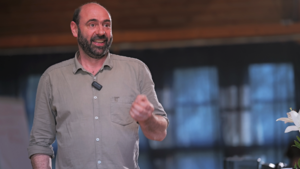
Transcription of the 3rd lecture on 2nd march 2026
Ready? So — and now I will carry on in French. No, just — this I only have in French. So I'll tell you the story.
We have a region in France that is called Jura, that is close to Switzerland. And they make this cheese called Comté. And it's a quite wealthy agriculture, where they aim everything on the quality of the grass for the animals. And it's the only part of France where people fight to get the land to plant vine or to put cows, you know. So some people from one of these dairy farms came to me a few years ago. And an interesting point, it's two generations, the father and the sons. When two generations on the farm agree, it's interesting. The father was organic since a long time. And the two sons took over the farm. And the father is still around, you know how it is.
It is 1,000 meters high. It's the coldest place in France in winter. But it also gets very fast dry in summer. And those two guys come to me and they want to learn how to make the preparations. Because they've been using the Prepared 500 and the 501 that we sell. And they come and they say, we need to tell you what we observed. We started using the preparations — and I can't remember if it was four or five years before. And they have seen a change in the soil structure. The structure is getting better. They have less problems with the rats going under the soil and eating by the roots. They start with the legumes and then carry on with the rest. They have now less problems than the neighbors' fields.
When you change the quality of the food for the animals, you see that the milk production is doing like that. It has a name. I don't have the name in English, sorry. And they see that this change, this reduction of the production, is far less than it was usually. After four years, they say that now the vet is coming on the farm more often for the other animals than for the cows. And the other animals are dogs and cats. So altogether, you have something that changed within a few years on the soil, on the crops.
And the last point is, when there is a dry time in summer, the grass starts two weeks before the neighbors again after the first rain. And this is something I observe quite often. On biodynamic farms, usually the grass will dry later and start again before, comparing to the neighbors. So, interesting.
And then, in this region, they don't make the cheese on one farm. For the Comté, you have to have a minimum of five different farms, I think it's five, to gather the milk and to make the cheese. And those guys already managed to do that, to turn this cheese-making place organic. And they say, now, if we want to turn it biodynamic, we need to show the people the difference.
Setting Up a Simple Field Experiment 00:04:43
And so they asked me to help them, and we settled some simple experiments. And so they will spray the preparations in autumn '23 and in spring '24. And I will go there to observe the results, to observe the fields with them, in September, the 24th of September '24. So it's not a long time. And we put different experiments on different places. And we go on two different farms. And it's interesting to have — you see, on this farm, we have three different plots where we settle experiments. Because sometimes you think, oh, maybe this was — we were very lucky on this place. If you have three different places, with different soil behavior, with different problems — and I ask the people usually, because very often the people want to take places where there are problems. And I say, well, let's take one place that goes very well, and some problematic places, so we can see how it goes in different situations. So here are two different situations. And we will look at one of them.
And so we go, and here we don't see anything anymore. Close that. Is it enough? No. Can you pull that up? No. Thank you. Thank you. Oh, but there's one more here. Do you see the difference?
So, okay, we do something quite simple. If we take a place like that, we just make sure that the field — there's no change in the soil, there's no change in the slope, that the vegetation is quite the same. And this is the place where we will spray. So this will be the control, and this will be another control, organic. I spray until here. This part, with the Prepared 500, in autumn. So, this is sprayed in autumn. And I spray this one in spring. So you can compare. Nothing. Autumn. Autumn plus spring. Spring. Nothing again. It's very easy.
And I always do that on farms with animals. Because the idea is, it's not always the same. On some places we have amazing results with one spray in autumn, and on some places we have amazing results with one spray in spring. And sometimes you want to go a bit faster, and you wonder, should I spray twice in the year? But, if you have dairy cows, you don't have the time. And spraying the preps is always at the same time as milking. So, we can take the time, we can find an organization to do it, but first I want to make sure it is necessary. So, this kind of experiment gives an idea. So, we go there.
Sprecher 5: How wide do you make the stripes?
How wide? It does not need to be very wide. Here we have space. I don't remember exactly, but usually I consider — if I go from here, I start here. This part I will not look at. This is the border with the other one, I don't look. So, I need that again, where I can look, and that again, where I don't look. This is not precise, but it gives you an idea of how I look. And you can also, from this part here, with the control — I spray with the backpack sprayer, and if I want to spray here and not there, I walk and I spray like that. So, I am sure there is nothing here. But still you keep at least 2 meters, if possible 3 meters, where you don't look.
So, here we see the result of autumn plus spring, and control. And we look from closer. This is the control. Organic control. This is autumn plus spring. And this we just put together. Can we switch that one off for 2 minutes, or not at all? Is it better for you? It's just 3 pictures, but if you see well enough, it's fine. Thank you.
So, here we have autumn plus spring, and here the control. We see a difference in color. We go even closer and we put them aside. OK. And again closer, and now in the hands. So, you see a difference in the structure. This is more — all the particles are more round. It's not square. It is nice, but it's more square than here. And you see the color. So, we usually see fast differences in soils where we move the soil, where we cultivate. But here, this is to me the situation where the evolution is the slowest. And still it goes fast with not much.
So, the idea now on that — because on this first year they missed the spring 501. They did not do that. But we have a vet with a lab who wants to make analyses on the quality of the forage. There were a few results, but it's not enough now to conclude. So, I don't put that here. And I don't want to make any analyses on the quality if 501 was not spread. So, it is supposed to be in the coming season that it should happen.
Viticulture as the Starting Point: Vincent's Father 00:13:49
My idea is — we made a lot of experiments in vineyards. Most of what you've seen, not all of what you've seen, but a lot were in vineyards. It's easy in vineyards. Because the plants don't move along the year. Because there are many problems. And because there is a lot of precision in how people work. And that is a great place to start experiments.
And that was the beginning of the story for my father. When my father turned from being a biodynamic farmer to being a consultant — it's wine growers who came to him and said, can you help us? We want to start biodynamics. And he was not interested. And he said, no. He did not drink or appreciate wine. He didn't know anything about viticulture. And the guys insisted. And he said, OK. At the end he said, OK, but we do two things. One thing, we work as groups. In the regions we make groups. So the evolution will be much faster. And the second thing is, everything that we apply, that we do, we keep a control and we observe the differences. And if there is no difference, there must be a mistake somewhere. The mistake can be in the indication or in how it was made. And that is in the mid-'90s, '94, the beginning of this story.
And that was for me an important moment to see the change. Because my father was always doing that. When I was a child, I've seen him. He was sowing the same thing at different moments. Of the day, of the moon, of whatever. And then took notes and notes and notes of his observation. And then at a stage, he was writing to Maria Thun and saying, my observations are not the same as yours. Maybe there is something to change. Because it's not only at my place. And so on and so on.
So, my father learned biodynamics with Christian von Wistinghausen. On the line of Maria Thun. And then he made his way, meeting Podolinsky. And he made his way with those experiments. Comparing the different ways of doing. And so that was a good way to change. To improve the way to do things. And for that, the viticulture was a great help.
And what I do now, and what I want to do, is to take this knowledge and to bring it to the rest. We know how to change the quality in the maturation of a grape, if the year is too warm. We know how to help the maturity if the year is too rainy and too cold, and the maturation does not move enough. How can we find those right moments to apply the 501 also for carrots, and for apples, and for this, and that, and that, and that. So that's what we're playing with now.
We start — I'm saying that because I'm very interested — we start a lot of experiments, if everything goes well, on a farm that has 15 hectares of vegetables. And the idea is, OK, you have 4 hectares of potatoes. I think that the 501 will be best used at this stage, this stage, and this stage. So we should compare things. And if we manage to do the same on different farms, then we can also take with us scientific people to observe that. But first, we need to explore what we can do. So, it's a great game, and it's endless.
And one more step. A few weeks ago, I was in Austria, working there for Demeter Austria, and there were a few days for farmers, and there was one day for chefs and sommeliers. 70 people in the room, only chefs and sommeliers. And they want to know why the biodynamic products are better, and what story they should tell to their clients. And that's important. We need to feed those people, because, hey, it's good to produce, but those people are very good ambassadors for us. And then, there was a guy, a chef, who came to me and said, look, I am teaching cooking for chefs, and we work a lot on the taste. And I was like, I want to play with you, because I'm sure — they compare different carrots from different soils, for example. But I want to compare different moments of application of 501 on the carrots as well. I love the Rodelika. But we can play.
We can see the preparations, as I tried to give you an image before, as actors of a very wide living system. But it's also tools that we can use on our farms. So, nice thing. And I hope, next year, results on the quality of the forage.
Institutional Research: INRA Colmar and Resistance to Stress 00:19:26
Some recent institutional research. If we want to get more light, we can get more light again. Is it good for you? Yeah.
Sprecher 3: So, a few things.
This was made — okay, INRA. When you see INRA, this is the Institut National de la Recherche Agronomique. This is the National Agronomic Research Institute in France. It's a big institution, the main agronomic institution in France. It has been used since, let's say, 70 years, to keep the chemical agriculture going, and to keep away all the other ways of farming, very clearly. There are a few researchers in there that want to explore what organic can do, what biodynamic can do. They don't have an easy life, but we're happy when they work with us.
This is from the INRA in Colmar, and they compared conventional and biodynamic vines. They looked at how the plants resist to stress, climatic stress, pathogen stress. They showed after a few years that it was very clear that there was a better resistance to stress in the biodynamic vines than in the conventional, that they had a better health, which they could see with the weight of wood, when you're cutting. Basically, we can keep it like that.
An interesting point is they call it an expression of the resistance genes, the genome. This brings to the idea that we have — too early. I need something else here. Can I... That's why I asked the question. Okay. So... You know what is epigenetic?
Sprecher 3: Yes.
Sprecher 1: From a scientific point of view, until a few years ago, it was not really allowed to use the word epigenetic in France.
Sprecher 2: I don't know what it is. What is epigenetic? I need to explain anyway.
Sprecher 4: In German we call it Herkunftswirkung. Herkunftswirkung. Die letzten Jahre, was hat die Pflanze erlebt, das hat sie noch ein paar Jahre.
The students from the February course, who are you? Did you hear about something in the course that is called the chaos? So, we take a break with this and I go on something else. We will come back.
Building Up the Farm Organism: Mineral, Plant, Animal 00:24:48
If I want to describe the farm organism, or even a bit wider than the farm organism, we have around us the realm of the mineral. This is a stone. In the realm of the mineral, we have a physical body. And what is able to act on a physical body is the laws of physics. No more than that.
What we have in a plant — we had a good look at that already, but — in a plant, the plant is building a physical body through a living activity. We have an activity. And that's where we can use this name of etheric forces. An etheric body is the activity that builds the physical body.
If we look at an animal — we have a cow. Animals, biodynamic guys, know how to draw the best. Because we are interested in fertility. And because this is the best animal all around the world to develop fertility. This is the metabolic animal, by essence. And this animal — the plant, through a densification, is making substance. Making new substance. And the animal is transforming substance. So, we have the grass. And a transformation here. And then we have the precious manure.
And Steiner says, at the end of lecture 2, that the animal on a farm is absolutely necessary, because it's the only one that is able to adapt to the place. What does it mean? And he calls something — Analyse cosmique qualitative. The cosmic qualitative analysis. Is it so?
Sprecher 4: Cosmic quantitative analysis.
Sprecher 1: Quantitative? Aha!
Sprecher 3: Quantitative.
Sprecher 1: Ah, not in French.
Sprecher 3: Qualitative and cosmic is the same.
Sprecher 4: Qualitative and cosmic is the same. Quantitative is another.
Sprecher 1: Analyse.
Sprecher 3: They need to read the book again.
That's the big problem with the translations. You never know if there's a mistake. Sometimes in the translations, you see that the translator tried to correct an idea. And most of the time, it's because he did not understand the idea. So, we might have a big problem in the French translation. So, we need to solve this problem for the French-speaking people.
Anyway, the idea is, the animal, while it is digesting, is able to take in the atmosphere. To take into its digestion, into what is being digested, an idea of what's around. And to bring into its manure something that is adapted to the place. That will balance unbalances of the place. And this is a mystery. How can the animal do that? So, it would mean that the animal is able to breathe in the atmosphere around. We will come back to that.
If we want to speak of a farm organism, we need to bring the compost. And we need to bring a human. And we can say that we have somewhere here a farm organism. I make it short. We would also need to have the sun, the planets, the stars, and so on, and so on.
The Cow and Chaos: Where Substance Loses Its Shape 00:31:16
Anyway, Steiner speaks of the chaos for the first time when we speak of the seed. And there are two chaos in the seed. And what is a chaos? He says, there is a chaos when the plant is shaping its seed. There's another chaos when the seed is germinating. And he will define the chaos as being a moment when the substance loses its shape. You cannot recognize it anymore. So, you have a substance, and you lose it. You don't recognize it. And then something else, something new appears. He says that this situation of chaos for a substance is a situation where outside influences can be taken into the substance. And that is where it's interesting, because we will see chaos. We will have it in different places. And we will need it anyway when we will discuss the stirring. So, it was not planned now, but it is now.
Seed Formation, Genetics and Epigenetics 00:32:44
So, what does a plant do when you have the seed formation? How many people here work on seeds? So, what do you do when you try to put a plant in a situation where you will improve something for the next generation? Improve something — it means because you have an idea. And maybe this idea is just to say, every year the plants have to cope with more unbalanced climate. Or we need to have more — we call it plasticity. The plant must adapt to a moment of the year where it's very warm. And the moment in 2023 by us was like that. It was a lot of rains and a lot of hot moments alternating. The plants have to cope with that. So, through the selection you can bring the plant to that. Or you make medicinal plants. And maybe you would like this plant — we know what is precious in this plant, and can we help it to build it properly.
So, the idea is, when the plant is doing its seed, from a genetic point of view, you have two mother plants where the genes meet to make the daughter. So, the genetics — this is two different plants and this is a long-time story of the plant. Careful, it will soon be epigenetic. So, this is the story that was written along the generations, and that is what your plant has in a seed. When you sow a salad, it makes a salad. And it doesn't make a dandelion.
And then you have the epigenetic. Epigenetic, it means what is on top of the genetic. And that's what the plant is able to learn in a season, for example. So, a plant that was grown here developed a relation with the kind of soil, the kind of climate, maybe the kind of people, maybe many other things, maybe the way the preparations were used and so on. And that, the plant is able to take from this generation and give something she learned to the next generation. And that is what we can call epigenetic. And you can play with that. You can play with that — I say that in a positive way because, for example, this is something that is known in the biodynamic movement. If you want to give more resistance to your plants, sometimes you should grow them more in altitude or more in the north. Was it developed here?
Anyway, that's a big part — just a little point. That's a big part of the biodynamic research at the beginning, in the first years. A huge part, we can say, because Steiner was convinced that we would have to work on not only seed selection, but also creating new varieties. And many people put a lot of work on that. And most of it, from what I know, stopped with the Second World War, because most of the results of the experiments were just destroyed and disappeared. But if you look, for example, at the little book about Keyserlingk, there are two volumes. And in the second volume, a big part is about this work. And there were quite a few people working on that, and a lot of work was made. And now, I don't know — here in Germany, in France, we have quite nothing about it. If you read only French, you don't find anything.
So, anyway, we can act, we can orientate the evolution of a plant. And that is the work people working on seed selection do, one part. I don't want to make this work too small. And now, so here, genetic, epigenetic. And it is easy to see on annual plants. And usually we say, if there is no seed formation, if the plant does not go through the seed formation — epigenetic, not sure.
And that is what this guy here, the one responsible for this publication, who is called Jean Masson — he has the same name as me, but we don't agree on many, many things. He was one of the first to work on the GMO plants for the wine in Colmar. Historically, in the family, it was a bit like that with him. And a few years before — so that was published in '18 — a few years before, he told me, no, epigenetic, we cannot use this word from a scientific point of view. Nothing is shown, and so on. And a few years later, he speaks about it. And that's an important point. We face a world of science that is changing fast. And when we bring things that this world of science does not want to see, to recognize, or whatever, sometimes we should also be patient, and we know that there's a fast evolution. And that's why it's interesting to have, in the conventional science, some people that look at what we do. Because it's a big base for our evolution.
So, they show that the way the plants resist better to stress — we were on climatic stress and pathogen stress — is the result of a different expression of the genome. And that's what I call epigenetic. So it means that on perennial plants, we can have an adaptation of the expression of the DNA, of what's going on in the genes, basically. If you're interested in that, the article is in English. And it's on our website. You can — because trying to make things short sometimes doesn't work well. You can go on this website. Most of the scientific articles I'm talking about are there. And you just need to note, like you write scientific reports, where you have this little thing like that. If you write the name here, you should find it. Yeah.
Germination, Chaos and the Archetype of the Plant 00:40:46
Second step. Our seed is now meeting the right conditions for germination. We have a chaos. Again, sorry, I was not precise on that. But what you observe here in the plant, when the seed is being built, it can be in two different ways. It's called mitosis or meiosis. And it's two ways of cellular fusion. Is it right with the words? Cellular fusion. And this is a chaos. If you look at it from very close, it becomes liquid and you cannot recognize anything. And then a new seed appears. And you have the same thing in the germination here. Just before, a little root appears. And then a germ. Just before that, it all becomes liquid. If you look at it with a microscope, you have a chaos.
What is this chaos able to take in? Well, you can choose where you put the seed, which kind of soil. On our farm organism, you will choose which animals you gathered on your farm to make the compost. You can have an influence on the evolution of the soil by the kind of compost that you bring. And this is not just an idea. This is a reality. If you have heavy soils and you bring compost that is made only from cow manure, you won't help your soils. If you have heavy soils, it's interesting to bring — not only a bit, but to mix the cow manure with sheep, with goat, maybe with horse, in a good balance. But this is something that you can use, again, if you have the possibility, because usually the main problem is to find the substance to make compost. But the choice that was made and the compost that was made, this is something that we can use. The way we use the preparations, this is also something we can use. The kind of soil.
Quite a few people working on seed selection also use their inner attitude. Many cultures around the world will sing to the seeds or carry the seeds with them before. We can speak about intention, we can speak about love, we can speak about many things. So we can bring around this germination many different influences.
But Steiner brings one more step, saying that this is the moment where the plant is able to make a connection with its archetype. The archetype, like the individuality of the plant. And the archetype of the plant will be somewhere in the furthest stars. And when the plant is germinating, it is able to go there and say hi to its identity. When your computer is too tired, you plug it into the internet and you load a new version, you refresh. And here the idea would be — the hypothesis for me is — that the plant is able to relate to its archetype and renew its original impulse.
An interesting point is that all the plants that don't go through the seeds, that we always keep on a vegetative multiplication, have degenerative problems. We know that each time a crop, a plant, goes through the germination, we renew something. We leave aside parts of the problems that the plant had in the last life. And this is a big deal for potato, this is a big deal for strawberries, this is a big deal for the vine. That it never goes through the seed. And that we carry along the time — more and more, the bag with problems is more and more heavy along the time. In the French literature, we can read about the degeneration of potatoes from 1805. For the vines, it starts around one century later. '8, '9, something like that. Interesting. And since there are quite a few wine growers here — we have more and more problems, and more and more heavy problems. If it was for humans, we would speak about a civilizational disease. And there is something to look at with that. I'm not interested in reproducing the wine through the seeds. Because I'm interested in keeping the old cépage. But I think we should work on regenerating them through something. If we have enough time, we can take a moment to speak about that. Not now.
Chaos Everywhere: Digestion, Compost and Stirring 00:46:41
But if we look at other situations in this little world that we just built, where do we have this chaos? Where else, than in the seed formation, than in the seed germination? We spoke about digestion a bit. And I told you, when I eat something, the first thing I will do in my organism is to just break it down. As completely as possible. You cannot recognize the protein of the egg that we had for lunch. I will keep only a very little bit of what I ate at lunch. But this little bit will be pure Vincent Masson. And we won't be able to recognize what it was before. In the digestion, I have a chaos.
What do we do in the compost? We gather different substances. They follow a first phase of breaking down. And then new substances are rebuilt. We have in a compost a chaos. There are a few places in our farms, in our world, where we can look at this idea of a chaos. This is a very nice one, but I only have that left.
Another place where we can use the same word? It's an easy one. Stirring the preparations. And we will talk about it later. With quite precise ideas. Steiner was very precise when he described the stirring. On how strong the chaos should be. He was precise when he described it. He was precise when he showed it. And everyone along our little history of the books, until 1941, agreed that the stirring, the chaos, should be very strong, very energetic. It must be a bubbling chaos. And you cannot do that if you have too big a volume. Even Franz Dreidax, in 1930, says that a normal human cannot stir by hand more than 30 litres. Because more than that, it cannot make a sufficiently strong chaos during an hour. Very interesting. OK. I hope I don't hurt anyone. So here, we have this chaos again. So we will come back to that at a stage or another. Now we come back. We can ground again. No, no.
Sprecher 5: Does that also exist among humans? Among humans.
Sprecher 1: Yes.
Sprecher 5: In digestion.
Sprecher 1: Yes. And maybe more. But humans are still too complicated for me. To me, we can look at the idea of chaos in many situations for humans, for a whole society — look at all the things. The order follows the chaos. Something where the order is too strong brings the chaos. I mean, you can look at the societies. You can look at political systems. You can look at many things with this idea as well. But it brings us far too far away from the farm.
Sprecher 5: Many things.
Scientific Results: INRA Dijon and the Interaction Networks 00:51:32
Sprecher 1: So, we go back to scientific results. This was a project — the INRA again, but from Dijon. Dijon is in Burgundy. It's not too far from my place. And one day, a guy — he's called Lionel Ranjard. He's very renowned in studying the soil microbiology. And he calls me, asks if he can come and meet us with my father. And he says, look, we're interested in looking at biodynamics. Many people in this movement are flying a bit too high. We've heard that you were people with their feet on the ground. Can we have a discussion?
Sprecher 3: Okay, come.
Sprecher 1: And we have a discussion. He had seen the pictures of soils that you saw before. He said, there is something that we should, as scientists, observe. And we proposed to him to go on three different fields where there were comparisons, organic, biodynamic, take samples, make their observations.
And those people developed, quite a while ago, something to read not only the soil microbiology — as, you know, usually soil microbiology, for a long time it was like that. Only a few years ago you would look at the microbial biomass. The more you have, the better it is. The balance, the microbial balance. Bacteria, mushrooms, fungi. And you should have an optimum. The green place is here, it's not in the middle. There should be 1% bacteria for 5% fungi. It's something a bit like that. And then you have the diversity. Who is there? And the more diversity you have, the better it is. And all this gives you the microbiological quality of your soil.
And then, those people in Dijon, they worked on something different. This is the interaction networks. How, when we have who is there in the soil, how does it communicate? How much do those organisms talk together? And you have some positive interactions, some negative interactions. But all together, the more interactions you have, the more positive it is for your soil. A community that has more links is more stable and more able to work than a community that has less links. If we want to make it short.
So those guys worked on that in France. Some other people worked on that in the United States, some others in Spain. And on this first experiment, they found that the number of links — so what you see here, there's a lot here, there's a few here, and those guys here are not very social. Here and there. And usually when you have something like that, some microorganisms that are not social, they can be pathogens. And they just show, on three different fields — we call them twins, so organic, biodynamic on the same field, it means that all the work is done the same, except the spray of the biodynamic preparations. Biodynamic. Quite more interesting.
Not so long later, there is a big call for a project, and it is from a national institution in France, and they give something like 400,000 euros for a research project that will work on the effect of different agricultural systems on the soils. We answered — so here we work together, with those people — and there were 18 different projects that fit in the call for a project, and we got the project. For you, maybe it doesn't mean much, but for me, as a French guy, that a national fund accepts a project where biodynamic is in the title, it's like, wow! It's amazing.
And the project is this one. We go on 150 different plots, only vineyards, in Alsace and Burgundy: 50 plots conventional, 50 plots organic, 50 plots biodynamic. And we make a lot of soil analyses, and many, many things. So we make all these things that we discussed before, and many, many things. And when we come to this, the interactions, we have something interesting. We make an average on all the plots. Organic, the average is 61,000 links. Biodynamic, the average is 152,000 links. That's too much. They have never seen such a difference. So they redo, and redo, and redo, and after 6 times, 7 times, they say, OK, we have to admit that it is like that.
So one of the conclusions of this experiment is — the objective of the study was to compare the impact of three agricultural practices, conventional, organic, biodynamic, on soil health, and the result is biodynamics comes on top, with a richer microbial activity and better interaction between bacteria and fungi, which are essential for plant nutrition. With scientific publication and so on and so on. Interesting. It doesn't help us for our daily work, but it helps us on a political point of view to say — do you think biodynamic is maybe not serious? Well, look, there are some guys who had results, and they are not from the biodynamic world, and those results you cannot contest. So it's important. That's why I spend time and energy to participate in this kind of thing.
Good Practice and the Microbial Results 00:58:40
On the 50 biodynamic estates, I made another little thing. I made a big questionnaire about this. How do the people work with the preparations? The quality of the biodynamic preparations and how they are stored. The quality of the water they use to stir. How is this water stored? How do you get it to the right temperature? How do you stir? Do you stir by hand? Which volume? Do you stir with a machine? Which kind of machine? which size? Inside, outside? How do you spray? Do you use the old sprayer that was used before for conventional sprays? Do you use something that respects the pressure that we say is the maximum pressure for the 500? When do you spray? And is it a plastic tank or not a plastic tank, for example? Conditions. Do you decide to spray the 500 because the Moon is there or there? Do you look at the state of the soil? Many things.
For example, for me, 500, if we don't have a soil that is warm and humid, it's useless to go. It's useless to go because I need to have a good biological activity in the soil. And bringing the 500, I will just — look, if I'm walking and someone comes behind me, he's running and he pushes me, then I will go faster. But if I'm laying on the soil, sleeping, you can push me, you won't have any result. And that's what we have in spring. When it's too cold, it's too early. We won't wake up the populations down in the soil. They need to wake up by themselves and then we can help. And for example, for me, the minimal temperature in the soil is 11 degrees. It's not for me. It's just because we know that 11 degrees is the beginning of waking up for the microorganisms in the soil. And you get this temperature — if you want to make it easily — when you look at the grass and we have it now. But you also make the average between the night and day temperature. And if it's lower than 11, it's too early to spray. Then if the soil is dry, you won't have the contact. It won't be able to get in touch. So we need to have a soil that is humid at the surface. So this is to give you an example. And then I have some people who will say, well, I'm looking for a descending moon on a root day. But if they don't look at the soil, it doesn't work, I'm sorry.
So with all this, that was the hypothesis that was built on my father's knowledge and my knowledge, what we used to see on the field that makes it work or not. And then the statisticians from the research institute tried to see if there was a relation between what I said was good or not, and what was the microbial result. And you see here, from my notation, 17% of the biodynamic estates were using bad practice. 51% good practice and 32% very good practice. So most of them is good. And it does that. Good biological state of the soil; not so good, not so bad; and there's a problem, we need to solve it. Most of the good and very good are on the good biological state. Most of the bad practice are there. So there was something that worked in what we did here. We learned from that and we made much more precise questions for the next step. But the idea is that we could have here the beginning of something that is more objective than my point of view about how we can get to the results or not. But still, tomorrow we will look at what it is, what I think is important from those different points.
And when I hear people who say maybe we should take the preparation sprays out of the Demeter certification, I hope the ceiling is high enough so I don't break it.
Graz University: The Microbiome of the Preparations 01:03:57
This is an interesting study from Graz University in Österreich, in Austria. And those people went on apple organic orchards. They first took a few different Prepared 500 preparations from Austria, from us, and they looked at the microbiome of the preparations. And then they applied the Prepared 500 to the orchard and looked at the evolution of the microbiome in the soil. And they showed that yes, there is a change, there is an evolution, and yes, we can relate it to the use of the preparations. Again, it's not useful for our daily work, but it's useful for how we talk to the world. And people working with apples — the idea of making experiments with 501 on the quality, that is interesting. What do you want when you make apples? Taste, color, storage — this is very easy to see the difference. It's the same with carrots. But there are more people comparing the taste of apples than of carrots. So we need to educate people.
Kassel University: Microbial Hormones and Stress Substances 01:05:37
Another one that is very interesting. Under the direction of Jürgen Fritz from Kassel University. And if I say something wrong, Yvette can correct me because she's in the room. Her name is there. So it's people from Kassel University, from Geisenheim University, from the Forschungsring, from the FiBL and us. I think that's it. And the idea was, we go on different places where there's a comparison of organic and biodynamic. On the same place, on the same field, you have a part where everything is organic and one part receives the preparations. This must be clear: when I speak of biodynamic situations, it's always only the use of the preps. But all the preps.
Sprecher 2: Just one question. Did you have any tests with conventional farming or chemical farming including these preparations, and did you see any differences there? Especially in comparison to organic. Maybe that's a point to make it more tasty to conventional farms. To just use the products and don't adapt the whole overall thinking. Are there any benefits in that, or is it just nonsense?
Sprecher 1: In French we have an expression that says, mettre un pansement sur une jambe de bois. Un pansement — how would you say that?
Sprecher 3: A plaster.
Sprecher 1: I'll find a... So I'm not interested. But yes, we did.
Sprecher 2: My idea was just a point to promote it throughout the whole farming community. Just not accepting these — let's not say traditional, chemical methods — but also telling the conventional farmers that we have something with a lot more benefits than what you are doing. And you can see the difference as well.
Sprecher 1: Maybe you will think I'm a bit radical. But I don't see the point. There are steps. But you can show — and we made experiments on conventional situations with biodynamics — but by saying to people, if you start biodynamics here, you stop the chemical products. You stop the chemical fertilizers and you stop the chemical pesticides and so on. Just something being logical. What we see here, in this kind of slides and in the soil pictures that I show — each time we bring the Prepared 500, but it's also the same as the 500, we stimulate what I call this metabolic world. More bacterial activity, more fungal activity in the soil. If you bring a fungicide, you just kill all that.
But I'm not even interested, because to me we have steps, and the first step is agronomy. Agronomy — if you don't know anything about agronomy, don't go biodynamic. You will kill the image of the movement everywhere. And that happened already as well in the organic movement. Agronomy is how you manage your soil. Which varieties of plants, which animals you use. Is it adapted to conventional, or is it adapted to organic farming, or even to biodynamic farming? It's not the same. If you prune a tree, if you prune a vine, just by the act of pruning you can create a lot of problems. This is agronomy: how I plant, how I prune, the quantity of fertilizer. This is the base of agronomy, and you know that each time you bring too much, you put your plant in a situation where they open the arms to the diseases and to the fungi. So this is agronomy, and we cannot farm without agronomy. Podolinsky was very strong on that, to say, first be the best on the agronomic level, and then you can bring biodynamics on your farm. But remember what Steiner proposed to the medical doctors: first you need to be the best in your knowledge, and then you can bring this widening of the art of medicine.
Second point, organic practice. And this is what? What is organic in Europe now? No GMO. No new GMO either, by the way. If you're not aware of that — this is a huge problem that we have, and it will be voted on the European level in a few weeks only. It is still time to go on the internet and say, no — we're the last place in the world where we don't have those new GMOs allowed, and they are a huge problem. Anyone interested? I'm sure there are people who know a lot about it. And does anyone have the little card with the biodynamic movement?
Sprecher 3: Yes.
Thank you. Take a look at that before you leave the room and take a picture of that and act. Can we leave that somewhere here?
So, no GMO. No chemicals as fertilizers or as products. Organic farming is a farming that refuses many things. That's what builds the identity of organic certification. Biodynamic is a third level. Biodynamic practices as well. This is the use of preparations. This is developing, or going towards, a farm organism. This is using compost. This is taking care of the landscape and the diversity. I don't put the moon calendar. I don't put the intention. We can use them as complements, but they are not our base. They are not our identity. So if you don't first go there, to me it is useless to go there. Because you don't create the conditions for it to work. Maybe you will see something, but you will stay in a way where you destroy more than you help. That's why I'm not interested. And when conventional guys call me and want to start with the preps, I say, sorry guys, I'm not selling preps for you. Except if you are on the way to leave chemicals. Then yes, we can help.
But if you have an example of a farm that is conventional, that would like to move away from this situation and that needs a bit of help — what you find in the regenerative agriculture is very interesting. And it can help in a very easy way. Compost tea, for example. It's for me a good first step to then go further. But we need this first step. It makes it easier. That was the answer.
Microbial Hormones and Stress-Support Substances: The Results 01:14:42
We go back there. Questions are allowed. But the answers are usually long. So here, the work was made on 36 repeats in Germany and 21 in France, I think. That I have here. In Germany it was on three different places, but all together it's 36 repeats. So 36 times organic, biodynamic, organic, biodynamic and so on. And in France it was not in an experimental situation. It was in the field. And I provided, from my network, places all around France. So very different kinds of soils, climates, crops as well. 21 situations where we could compare on the same field, organic and biodynamic.
If we come back to this image of the plant that is feeding the soil — the plant can feed more or less this or that microorganism. Some microorganisms in the soil will make what's called plant growth promoting hormones. Those are useful hormones for the growth, to stimulate or to regulate the growth of the plant. You have some microorganisms that can produce that. You have other bacteria and fungi, microorganisms as well, that can produce substances that support the plants in situations of stress. And it can be climatic stress. It can be because it's too hot, because it's too humid, because it's too dry. So what was looked at was how much of those substances is produced in the organic part and the biodynamic part. Is it OK? Is it clear? You look like people when the end of the day — should be necessarily not too long. The level is a bit going down. 15 minutes, is it OK?
This is on two different situations. Air is important. Good idea. Thank you. Here we're in Frankenhausen, and I think this is 16 repeats. I'm not sure of that. This is about the 21 situations in France. You have here in green, organic; in red, biodynamic — the microbial hormones. And here, this is the substances that help the plant to adapt to stressful situations. The general one, and then the detail. Each time you have one star, it means that from a scientific point of view you have significant results, significant differences. Two stars, highly significant. T, tendency. It's not significant but really not far. For all the substances, we are happy when we have more. It's not always like that. But here, all the substances, if we have more, it is better. And you can see that everywhere in the organic we have less. Everywhere in the biodynamic we have more. And very often we have this star, this T, this double star, in many, many places. That is interesting. That is related to the use of the biodynamic preparations. And that is an effect on the growth and on the health of your plants. When we spray preparations, we don't spray ideas. We spray something that changes the world. That changes our world. So, that's great. Yeah, it is. And there's more, but I show only a part of it.
Sprecher 5: So, in general, preparations are used. Not specifically produced.
Sprecher 1: In France, I think that is always 500p. Also in Germany, I don't know exactly.
Sprecher 4: I think it was 500 and 501 in Frankenhausen.
Sprecher 1: Yes, but normally it should always be — if it is only 500, then you should also have the compost preparation.
Sprecher 3: Yes, yes, yes.
Sprecher 1: So, it is like that. I think a part is with 500p because it is from me. But with others, I don't know exactly. Everything is in the article. There is a publication. To me, each time there is an experiment, if you don't have 500, 501 and the 6 compost preparations, it's wrong. We cannot expect from it the full working of the preparations. And that is clear since the beginning of our story. Our story as a biodynamic movement.
A Meta-Analysis: Soil Quality Across Farming Systems 01:20:31
Another one. That is a meta-analysis. Someone — she is called Amélie Christel — and she worked also under the direction of Lionel Ranjard from INRA Dijon, which we named already. And she worked on all that was published about the impacts on the soil of the different farming systems. Conventional, regenerative, organic, biodynamic. It was a time where she had to work in an office, so she could not go in the field. And she just made this meta-analysis, which is interesting. And she could not conclude anything about regenerative, because there are not enough publications. But she could show that on all the things that were studied, the soil quality is always better in organic systems than in conventional systems. All the things are better in biodynamic than in organic. Very simple. But we need this kind of things.
So, that was my little view on recent publications. And when I say publications, it means that all those works have been published in this kind of papers where you have a very strict control before it is published. It is not me calling it scientific. It is accepted by the scientific community as institutional research. Peer-reviewed.
Sprecher 1: Thank you, I did not know the word. Peer-reviewed papers. That is how it is called.
Closing: The Program for Tomorrow 01:22:32
That is it. We have 10 minutes. Any questions? Tomorrow? Well, those results, for me, need what I call good practice. For example, that is what we will explore tomorrow. But I named them already. Where are we today in terms of know-how about the quality of the preparations — and we will speak about the colloidal state of the substance. Which is, I think, a very important step in the quality of the preparations. How to store the preparations. Which quality of water for stirring. We need to warm the water before stirring. Any living organism has a proper temperature. Nothing is living that is cold. So what is the right temperature? How can we get it? What should we not use? Direct use of electricity is a problem. It hurts the quality of the water. So we will look at those points. How to stir? How to spray? How we choose the right time? And observable results, of which you've had an idea already. That is the program for tomorrow. And that might bring us into more discussions than today. And then we will go on to how we make the preparations at our place. That's it. Is it enough for today? Yes. Thank you very much.
Have a nice evening.
Links
- BioDynamie Services
- https://www.soin-de-la-terre.org/categorie/autres-thematiques/vincent-masson/
- Source concernant l' anthroposophie anthrowiki.at
| English eposides 1 - 2 - 3 - 4 - 5 - 6 - 7 ... |
| Deutsche Folgen 1 - 2 - 3 - 4 - 5 - 6 - 7 ... |


