Eine freie Initiative von Menschen bei  anthrowiki.at, anthrowiki.at,  anthro.world, anthro.world,  biodyn.wiki und biodyn.wiki und  steiner.wiki steiner.wikimit online Lesekreisen, Übungsgruppen, Vorträgen ... |
|
|
Use Google Translate for a raw translation of our pages into more than 100 languages. Please note that some mistranslations can occur due to machine translation. |







Best practice of biodynamic preparations - 4 lecture by Vincent Masson, 2026
A B C D E F G H I J K L M N O P Q R S T U V W X Y Z | 0-9
| English eposides 1 - 2 - 3 - 4 - 5 - 6 - 7 ... |
| Deutsche Folgen 1 - 2 - 3 - 4 - 5 - 6 - 7 ... |
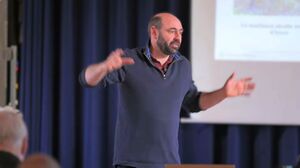
Transcription of the 4rd lecture on 3rd march 2026
The Behaviour Model: Substance as Carrier of a Process 00:00:17
Good morning. Did you have a good rest during the night? We still need one minute so that the — is it okay now? Perfect. So, we don't need one more minute.
We have a long day today. We start now at half past eight and we finish at sixteen — eighteen, sorry, yeah. Six, eighteen, sorry, thank you. And maybe — I'll try to make two breaks in the morning and two breaks in the afternoon. That means about one hour and a quarter, something like that. And you have to tell me when it's time, because I won't see the time within one hour. But maybe it's better to keep going the whole day. So, no hesitation to tell me, hey, it's time.
We had a good introduction yesterday and we will carry on today. And we will go on to more practical things. There is one point about research yesterday that I didn't discuss. But I'll keep it for later. We made a work with some wine growers in France and with some scientists about copper. Is there a problem with copper when we use copper on trees, on vegetables, on vines? So, we made a work, we published on that in France, we published in English. And I don't want to start the day with that, because then it makes me a bit too — it is a very political problem, and it is an important problem for the whole organic movement in the near future. So, I keep that for another moment, but we will discuss that anyway.
Yesterday, when we spoke about the equisetum, I said a few words about the substance and the process. How a substance is the result of a process. And we will go a bit more into that, because it's another way to look at the preparations. We use only very small amounts of each preparation, because we don't need the substance to be active. We just need the substance as the carrier of a process. And the concept of a behaviour model is something we can borrow from anthroposophic medicine.
When we want to make a remedy, we need to find the right substance. That was an idea of Steiner — that around us, in nature, we can find everything that we will need to heal ourselves. We just need to be able to recognise where lies, in which substance lies, the result of the process we need. And this is an example, with an oyster shell. We know what it is as a substance. We know what it is as the result of a life. But what is the know-how that is in this substance? What is, in a way, the wisdom that we can learn from the oyster shell? Any idea?
Audience: I don't know, but we make something very hard out of very liquid inside. Sometimes we make pearls. And there is a very watery consistency that creates a very hard material. I don't know, I'm just thinking out of my head.
Vincent Masson: Okay, that's one point. What is the oyster doing? Main activity in its life. Filtering water. Filtering, filtering. It takes what it needs to eat. And it also takes calcium, which is in minimal quantities in the sea water, as many other substances. But it's very specialised in taking the calcium and making an outside skeleton with that. Highly specialised in finding and fixing the calcium.
This is in the animal realm. But we can also find this in the plant realm. We have a plant, and it's one of the preparation plants, that is able to do that in a special way. So, animal realm, plant realm. The oak. We know that the oak is able — and we know that for a long, long time. Steiner speaks of it. Pfeiffer gives numbers, that the oak is able to put in its bark a big amount of calcium. Even when it grows on soils where there's no calcium. You go on granitic soils, and you will have in the bark of oaks up to 70, more than 70% of calcium. Where does it find it if it's not in the soil? And how is it? There is something very similar. There are many other things. It's only little amounts of substance, but it's able to take it and to fix it. So, a special relationship to the calcium.
We as humans — there are moments in our lives where we need calcium. And one possibility is to say, take the right amount every day. That's like Justus von Liebig in agronomy. And there's another way, which is to say, can we find somewhere around us an example for our organism, for our body, to find the right behaviour towards calcium? And the moments where we need calcium, it is young children growing fast. It is mothers, future mothers, pregnant women. It's when we age; people making a lot of sport, they need more calcium. And the anthroposophic pharmacy makes a remedy called Calcarea. There are quite a few different ones. Based on oyster shell, oak bark, and a mineral. So we have the three realms. A mineral that is called apatite, which is very close to the bone composition. And from that, a remedy is made that is a homoeopathic remedy. We don't take any substance, we don't take any calcium. But through getting the substance in the right stage, and getting this substance through potentising, we awaken the process again. This knowledge of right behaviour towards the calcium.
So we don't bring to the body an amount of calcium, but we bring to the body the model. That's what I call — maybe other words could be better — the model, the behaviour model, to the organism, to find the right relation to the calcium. And that's an idea that we can have in mind when we stir preparations. We take a little amount of substance, that is a representative of the processes we want to develop. And through the stirring, we bring it into activity again, we bring the process into activity again. So that's one way to look at the preparations.
Using Plants to Heal Plants: The Willow 00:09:58
One more — I told you yesterday, there are many different ways. And this image, we can use it to understand the preparations, but we can use it as well when we want to use plants. When our crops need a bit of help. And for example, if we need copper. Copper is interesting in a way, but we like to use less. When we use copper, when we use sulphur, we like to reduce the amounts used. And using plants, using teas, is a good way to help. On one side, you use the copper and the sulphur to fight the fungi. And on the other side, you will choose the right plants considering the situation. The situation of your plot, of your plant, of the climatic conditions at the moment. And you choose plants to help to raise the level of health of your crops. And that's a mix that we work a lot with. And that helps reducing the elements. And this idea of a behaviour model can help us a lot to find which plants will be the right ones in which situation.
So, I don't think we have time to discuss this part of plants, and how to use plants to heal the plants, in those days. But this is an important base for that. And we can maybe just take an example. Because we had the example of the equisetum yesterday. Another plant that is interesting is the willow. Willow, Weide. Where does it grow? Which conditions? Water. It grows under the influence of water. And you can even have the trees growing in the water. And it's always healthy. And it makes very light — the woods are coloured, light. The structure is very in the air, in the fire. It is not like a plant that has plenty of water, that is taking the water.
Audience: If I show you willow.
Vincent Masson: Fine leaves. Light green. Coloured woods in the winter. Would you imagine that this plant is growing very close to the water, in big quantities of water? Not really. It's not this image of wide, deep green leaves and stuff like that. So we have here a plant that is able to manage the excess of water. It is living in a very metabolic atmosphere — not atmosphere, but ambiance. Places, whatever. Umgebung. But it doesn't take it. It is sober towards water.
And this plant has an active substance that is the salicylic acid. Which is the one that is used to make aspirin. And that is a regulator of the fluids in the organism. And the salicylic acid is only one part of what the plant can do. Because if we take only this substance, if we isolate it, we don't have — and it is the same with all the plants. When you have a plant that is known for medical purpose, if you find the active substance and you take only that one, you reduce the activity of the plant. And if you take this substance and you make it synthetic, you reduce even more. We can observe always the same process. But if you have the plant, you have the substance and you have what the plant learned. What the plant is able to give us from how it lives in relation to its environment.
We use the willow woods. The wood from the year. So we harvest in winter. Usually by us we harvest that in January. Because we want to harvest before the sap starts moving. And we will take 100 g per hectare of this dried wood. And we make a tea. The salicylic acid is fragile. And if you get the temperature of the water higher than 65 degrees, you hurt the salicylic acid. So we don't raise it more than 65 degrees. And we use this tea to help the plants in situations when there is too much water. Too much water. The climate is too humid. You have rain, rain, rain. Or you are close to a river and you have fog. Very long periods of time. And that will help the plant get more — make like that. When the excess of water brings the plant in this direction, we put it back towards itself. Very easy. Very practical. You can grow this plant anywhere. And this kind of willows, we don't need. We cannot use them. Because they don't have the right gesture. Those willows take the water and make surface, those willows take the water and they run down like watery trees. They don't have the right relation to the water. So that's just another example.
We call it — what's the name of it in German?
Audience: Trauerweide.
Vincent Masson: It is under the influence of the water. In the whole shape. So it doesn't manage the water.
The Colloidal State of Substance: A Look Through the Literature 00:17:19
We can start talking of the colloidal state of substance. Because we will need to bring all the preparations we make into a colloidal state. And the colloidal state, for me — we need to understand a bit what it is. Because we want each preparation, when we take it out of the ground, to be as close as possible to this state. And we want to keep it in a colloidal state until the moment we use it. And that's why we will need to care for them in the cellar. And never forget about them. And never let them go wrong.
What is this colloidal state? First, a little look along the history. And we go to this little bibliography we had yesterday. And we just read how people described it. But first — the first is Almar von Wistinghausen again. And I don't know when that was written exactly. But it was published in 1982. In this book, Erinnerungen an den Anfang der biologisch-dynamischen Wirtschaftsweise. And can you read this part please?
Audience: The forces described in this book can be properly distributed with manure or compost, if the organic substance is created in such a way that it is able to absorb these forces. As soon as the substance is too wet or too dry, or the air cannot adhere properly, the earthly matter is closed against the absorption and mediation of life forces.
Vincent Masson: Then, in 35, Pfeiffer in his Practical guide to the use of BD preparations, this book w s first published in 35 as a private publication, only for the members of the circle of experimentation. And then republished in 1938. As a public document. "The preparations 502 to 506 are themselves plant substance in humus condition." Kabisch later speaks of semi-solid compost preparations. So we always have this idea that it's not dry. That it's not liquid. That there's this in-between state.
Koepf, in Biodynamics Press '71, writes they should not be allowed to dry out. And in '80 we have something new. I don't know where it comes from. I didn't find any mention of it before. Niklaus Remer, in Organische Düngung, writes: keeping the medicinal plant preparations in well-dried condition. And we will find that again.
You see these little green and red books, about making and using the preparations, from Wistinghausen. And so the first, in '81, is green. And it proposes both. It says we can store them in dry or in humid conditions. In 2005 there is a reprint of this booklet. And the first, the '81 version, was from Wistinghausen — so now it's not Almar von Wistinghausen, it is Christian von Wistinghausen. It was Wistinghausen and Scheibe. And in 2005 there are two more authors: Eckart von Wistinghausen and Uli-Johannes König. And they also propose the two ways. But they give a clear orientation on the fact that it's much better not to dry them out. Much more dangerous to keep them in humid conditions. It's like they don't take officially a position. But they really lead you to understand what they mean.
We then have Alex Podolinsky in his booklet Practical Notes. And he has a very precise idea. “The preparations must be kept in the same colloidal humus condition as it was when lifted from the ground. And it should be like fresh worm casts. Otherwise the effectiveness is lost.” You have the fresh worm cast. You get it? Worm cast. Yeah, you know what...
Audience: This one?
Audience: Bodenpraline.
Vincent Masson: Bodenpraline. But you have the texture. You see how humid it is when it's fresh. He says this is the right state and it should always stay like that. Otherwise we lose the efficiency.
Audience: What is the Bodenpraline? Wurmkot.
People Who Understood the Importance of Colloids 00:23:32
Vincent Masson: There are some important words. When we look in the anthroposophic movement, we have a few people who went very close to understanding the importance of colloids. And I name here three people. Rudolf Hauschka, Friedrich Benesch and Walter Kloos. With Friedrich Benesch we have a problem. He wrote very interesting things. He understood very deeply many things. He was a priest in the Christian Community. And after his death, people discovered that he was deeply involved in the Nazi time. So it's always a question. What do we do with this kind of guys? So I mention that. I will mention one or two sentences from him. It's important to know that he is one of the guys that put us in trouble with this thing.
The others — Hauschka, Cloos. Cloos was one of the founders of Weleda. Hauschka — you know Hauschka, Dr. Hauschka products and Wala. They speak of the importance of the colloidal state for what is living. And also in the process of evolution. Rudolf Hauschka.
And that's an interesting point. A colloid. We should get a bit closer to what is a colloid. The colloidal state of a substance is an in-between state. Not solid. Not liquid. Not gaseous. But it has at least the qualities of two of those different states of substance. And then it cannot be stable. It is not solid enough to be stable. It is not liquid enough to be stable. It is an in-between. And it is a state where the substance can be taken by life. And life is only present on our planet when you have this colloidal state of substance.
Well, I have an example of a colloid here. This is prepared 500. And you see how it is. It is like a paste. Very humid. Very fresh. It doesn't put much on my hands. If it goes all around with all your hands, it will dry out along the way. Take a look. And don't forget this is fresh. This is pure cow manure. And you can smell. And if you taste — don't take too much. There must be left at the end. And this — have a look. This is for me the right state the preps should be in. And should stay in.
Audience: How do you call it for children? pate à modeler. They can play. modelling clay
Audience: Knipmaz.
Audience: Yeah. The Knipmaz.
Audience: This is 500 you made? Yeah. When?
Vincent Masson: This is from last year. Or from the year before. Probably we are now — I don't know exactly. Either it was taken out last April, or the one before. I don't really care for that. Because we always first use the oldest. And in all the — you will see one of the pictures of the storage at our place. And we look in all the boxes. And we first take what is the most advanced. Something where it's completely colloidal. Because some don't have the evolution at the same speed. Difficult to say. So we just look at what is right and we take what is right.
Where are the bits of 500? Did you have them?
Audience: Yeah.
Audience: All the time?
Vincent Masson: No, that is what I take for travelling. I'll show how I store. Take it more fresh. This is more fresh.
Audience: Because it dries in the hand.
Vincent Masson: Like henna. That's a new one I've never heard before. Better smell?
Storing the Preparations: Air and the Big Jars 00:30:55
Important detail. Now, those bits have been pressed, more or less. Before I put them back in there, I break them into bits. Because I don't want to keep the compaction. If you receive 500, someone has been carrying it in a bag. It is pressed as well. And just open it up so that it can breathe. This is a living substance. And it should always be in relation with air. Which means that — OK, this I took in the cellar Sunday morning. Before I went to the train. And just to travel, I have these little holes in the lid. Air. Everything that is alive needs a relation to air.
But a special thing. When we store this at my place, we have quite big jars. We have about 60 kilos in one jar. And when you go to the bottom of it, there is no relation to the air. Because it is quite compact. And a very interesting point is that it stays healthy. It stays sane. Many, many substances, in this level of humidity, if you store them like that, would just turn wrong. It would go mouldy. And this, you can keep it for months, years. It always stays in a healthy state. And for me, this is in relation with this colloidality. A colloidal state of substance is not life. But it allows life to take hold of the substance.
So, we find colloids where we have soil fertility. In the clay, Ton. In humus. We find colloids in the plant liquids, in the plant sap. We find colloids in the animal and human liquids as well. And each time you have a substance going away from the colloidal state — usually, what we have in the evolution, if we lose the colloidal state, our bones only will stay there. Everything that is organic substance will be taken back in the cycle of life. And what is too solid will stay.
And if we come back to this idea of the evolution of the planet, as I very quickly spoke about it yesterday — saying we have first this body of warmth. We have then this body of gas. Then liquids. And then going to the solid. So, old Saturn and so on and so on. And going to the solid, we still have colloids. And that is the humus. That is what allows life to be on our planet. And if we carry on the evolution, we go to something that is purely mineral, out of life.
All the mineral realm, before it became solid, was in another state. If we look long, long time ago — did you never wonder why in the mountains you can have round shapes of rocks? Would it be possible if it was solid, when there were those movements? If there is a movement and something is solid, it breaks. If there is a movement and something is liquid or creamy, then it can make this kind of shapes. So, next time you drive through the mountains, have a look at that and wonder how was the state of substance a long time ago. And we are not there. And we don't want to be there too fast. Otherwise, we will say bye. Bye.
So, that gives an idea — I hope that gives an idea — of the importance of the colloidal state of substance for life. That's just two images. I don't know how much we can see on that, but of 500 in the state as you've seen it, and 500 as it can also sometimes be found. Nettle preparation made of stored dry and stored humid. That was a big story in European countries during the '80s and '90s. People were fighting. We want dry preparations. We want to keep the preparations wet. And now there's more and more an agreement on: it should not be too dry. But I see in many places where people say, now we make wet preparations, we keep them humid — it's not humid enough. And how many of you said, oh, it should be that humid? Yeah, I know. Yes, it should. We don't want to be half dry, right? To be alive, we need our right level of humidity. And this is, I think, the right level. So, we have to dare. Because very often you will say, will it turn wrong if it's so humid? And we need to dare.
Audience: So, when you said that you have these 60 kilos of preparation and that at the bottom it's a bit more compacted —
Audience: Yeah.
Audience: Is there, like — can you smell that? That there is no, like, stick? You know, sometimes in the soil as well, you can have water over water.
Vincent Masson: You had the smell here?
Audience: I didn't have enough time.
Vincent Masson: Then take the time. The smell at the bottom of those big pots is the same as this one. The only difference is that we will have, in a bigger jar, more smells from the worms. The worms that develop in that are Eisenia fetida, and they have a smell. But apart from the smell of the worms, I have no smell. Otherwise it means there is something wrong. And I need to do something.
Salts Destroy the Colloids 00:38:27
So, again a few — on colloids I like to rely on some people who say it better than me, right? So — again, this is from Walter Cloos. The first is in The Living Earth, chapter 4. And the second one is in Menschengemäße Heilmittel, which is a very important book. Can you, please.
Audience: “This means that they would slip out of reach of the life forces, for these can be alive and formative only on substances in the colloidal state[…] Salts destroy the colloidal state of the soils because colloids are flocculated by salts. They can then no longer be a vehicle for life forces.”
Vincent Masson: Important detail. When we speak of salts, we call salts the chemical fertilisers. And that is a complement to the answer to the question from yesterday. We cannot help building colloids in the soil and at the same time destroy them. And we know, for example, that herbicides — yeah, they destroy. The organic matter in the topsoil cannot hold anymore. We lose it. So we go against what we want to build. Thank you.
“According to the many indications given by Rudolf Steiner, the most important now is to recognise that this macrocosmic nature is already completely dead and basically lives only in echoes that in the processes of the nature realms become more and more muffled.”
We're more and more in this state and we're less and less able to receive what comes from the periphery. Do you have the book?
Audience: Yeah.
Vincent Masson: You will have the next sentence, I think, by page 62. 61. Ein solcher Weg. Make sure — I don't know if it's the right one. Is it in relation with that one? Sorry, this one I didn't put the German in there. Does it look the same?
Audience: [reads]
Vincent Masson: Can you read that one once more?
Audience: Yeah.
Vincent Masson: That's a very important one. I don't know if you got it, but to me this is a very clear understanding of what a colloid is.
Colloids Talking to Colloids 00:43:14
So. The idea of a model that we started with this morning is interesting for agriculture. And the colloidal quality of a soil, the colloidal quality of preparations — it is a state where it can receive impulses from the outside. And it is, to me — with the preparations we want to address the soils, the colloids in the soils, the colloids in the plants. And if we have colloidal preparations, we speak the right language. If I talk to you in a language you understand, the day is fruitful. If I speak in French today, I'm not sure. So. Colloids talking to colloids. And that works.
There was — when there was this big conflict in Europe, mainly in Europe, about the state of preparations — then there was a guy in America, in Northern America, called Walter Goldstein. And he compared the same 500 kept in a moist state and dried. And with his experiments, he showed that with the same preparation, when it was kept moist, it takes it as 100% of efficiency. And the part that was dried, it has only 40% of efficiency. But it's easier to store when it's dry. You don't need to care for it. You can forget about it for the whole year. But do you work with 40% of efficiency? I don't.
So. We need to have the right substances, to have the right transformation during the stay of the preparation in the soil. While it is becoming a preparation. And then in the cellar, we should handle them, we should care for them. So that it stays always in the right state. And the question of the smell is one of the ways we can look at them. For me, we need to care in the cellar, we need to use our senses.
And we need to — is there anyone making cheese in the room? No cheesemakers here? People making wine. Yeah, a few. But when you live with animals, when you live with plants, you get a look. When you go in your garden, there are many things that the plants — maybe you cannot explain exactly why, but you would say, oh, there's something to do. You get it? And I'm sure most of you get it.
And this is — can you... French word to German... The word I'm trying to find is — I will visit you, but I will visit you often. And we will get used to meeting each other. And we will get to know — and this means that you get a relation with them. You get to know, and then little, very small details will talk to you. Like a smell. For example, at my place — at the moment, I'm not at my place. And we are two of us looking, caring for the preparations. And the other one is called Tom. And if I go in the cellar, when I go back, I'll have a little — I'll look at some preps. And for example, if one prep is — I need to look at it from closer. I would need to know if it was opened. If the lid of the box was opened yesterday or not. Because what the smells tell is not the same if it was opened yesterday or not opened since a few days. It's just little details. I don't have this problem with most of the preps, because they just — there's nothing to do. We just look at them, we check. But if there is one prep where maybe we should move it, maybe we should — then I need to have all the little details. And then, what I see, what I smell, what I can touch if I need to touch, is my basic relation with them.
The next sentence is bringing us a bit further. But I like it. And again, this little book from Walter Cloos.
Audience: You don't have the German name here.
Vincent Masson: I'll just find it to show you. If you want to get into something very deep about substance, transforming substance — about what it means to be an actor of these transformations. And so, I don't know if some of you know this book. But it gives great inspirations. So, I warmly recommend it. I don't know if it still exists. If it's too difficult to find — I don't know if I'm allowed, but I can share it. So, now we need our reader again.
Vincent Masson: Can you read it again?
Audience: "... All processes of decay and even weathering in the mineral and living kingdoms of nature transform matter into a germinative state.
Rudolf Steiner applied this fact in practice in the preparations procedures of the ’Agricultural Course". There, he describes a controlled process of decay that transforms the relevant plant parts into a germinative state. When used in compost making and stable manure decomposition, these decomposed plant parts act as starting points for etheric growth in the processes of humus formation."
Vincent Masson: So, do we have now a little bit of understanding of what I mean when I say a colloidal state of substance for the preparations, and why? Do you have an idea? Good. OK. Then, the next step will be about preparation storage, but I think we can have our first short break now. We take something like ten minutes? Is it OK? Very good.
Links
- BioDynamie Services
- https://www.soin-de-la-terre.org/categorie/autres-thematiques/vincent-masson/
- Source concernant l' anthroposophie anthrowiki.at
| English eposides 1 - 2 - 3 - 4 - 5 - 6 - 7 ... |
| Deutsche Folgen 1 - 2 - 3 - 4 - 5 - 6 - 7 ... |


